

Second World Summit on Social Development 2025
A Global Moment for Inclusive Social Development
At a time of profound global transition, the Second World Summit on Social Development sent a clear message: social development must be inclusive, human rights-based, and grounded in solidarity across generations.
With more than 14,000 participants from 186 countries, the Summit reflected both the urgency and the scale of global commitment to addressing poverty, inequality, social exclusion, and demographic change. The Doha Political Declaration adopted at the Summit reaffirmed States’ shared commitment to advance dignity, equity, inclusion, and participation—principles that must underpin social development in all societies.
From Potential to Progress: An Intergenerational and Human Rights Approach
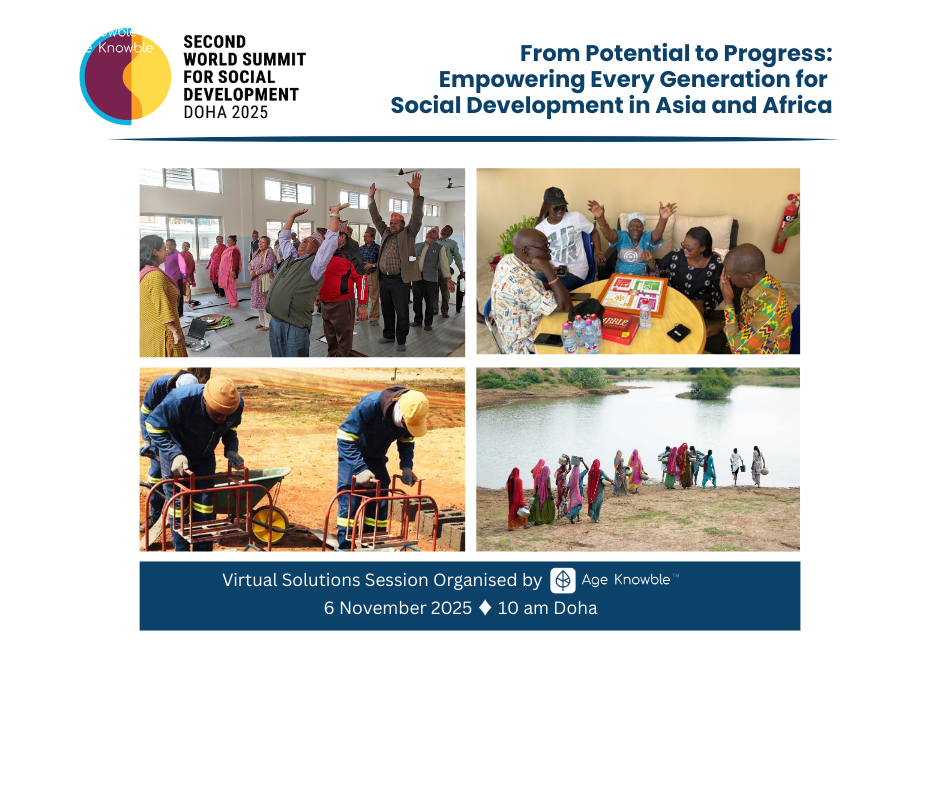
Against this backdrop, Age Knowble convened the Summit-aligned event From Potential to Progress: Empowering Every Generation for Social Development in Asia and Africa. The session brought together regional experts, solutions leaders, and solutions beneficiaries, alongside initiatives grounded in intergenerational and human rights approaches, to advance a simple but powerful proposition: social development moves forward when every generation is recognized as a partner in change.
The session was grounded in the principle of interdependence—recognizing that older and younger people bring distinct knowledge, experience, and leadership that, together, strengthen development outcomes.
From Practice to Solutions: What the Session Contributed
The dialogue highlighted the critical demographic reality shaping both regions: while Asia is home to the largest number of older persons globally and is ageing rapidly, Africa, despite its much younger age structure, is experiencing the fastest growth in the number of older persons, making intergenerational approaches to social development essential in both regions.
Building on this reality, the session surfaced solutions already delivering impact—including community-based health initiatives built on intergenerational trust; social protection approaches shaped by lived experience; climate adaptation practices informed by traditional and sustainable knowledge; and local solutions where older and younger people work together to address poverty, care gaps, and social exclusion.
In doing so, the session brought a grounded, people-centred dimension to the Summit agenda, demonstrating how intergenerational and human rights approaches translate global commitments into action, particularly in Asia and Africa.
Three practice-informed messages stood out.
First, older persons and younger people are both essential development actors. Framing one generation as dependent and another as solely responsible weakens social outcomes. Social development is strongest when contribution and participation are recognized across the life course.
Second, human rights-based and people-centred approaches deliver better results. Policies shaped with communities, rather than for them, are more equitable, trusted, and effective.
Third, South–South and cross-regional collaboration matters. Asia–Africa dialogue is powerful because the two regions share key social development challenges and opportunities, enabling the exchange of context-driven solutions rooted in lived experience.
Carrying Summit Commitments Forward
Together, the solutions and insights shared at the session complement and deepen the commitments set out in the Declaration, helping bridge the gap between global consensus and local action.
The submitted session Summary and the celebration video capture these contributions through voices, stories, and examples from across regions—showing how intergenerational and human rights approaches can advance social development in ways that are inclusive, practical, and responsive to lived realities.
Looking Ahead: Empowering Every Generation
As momentum continues beyond the Summit, one lesson stands out. Social development cannot be advanced by one generation alone. Moving from potential to progress requires intergenerational leadership, human rights-based action, and sustained collaboration across sectors and regions.
Empowering every generation—older and younger, together—is not only possible. It is essential.